yachiru: (Default)
I knew I was pregnant when the rabbit died.

I don’t remember my mother. She didn’t die in childbirth, she just left as soon as I was weaned. I used to imagine it was because it was like birthing puppies. I’d scan the faces of my grademates, wondering if they’d been part of the litter.

Truth is, my father was an asshole and she’d left him for it. I admired her for that. I loved the idea of her, the fantasy that somewhere out there my mother was a strong woman. She was in Alaska, drilling for oil with her arms glistening and muscled. She was on the plains in Texas, roping steers and breaking skinny chested men’s hearts.

Then my father died, falling down the stairs of our old antebellum house. He’d been drunk, he was always drunk.

Now it was just me. Or maybe someone else if I was pregnant.

I wasn’t sure but I felt different. There were the obvious signs. Nausea. Missing periods. Frequent feelings of existential dread.

The dreams were a part of it. Every night I dreamed I was in a vast empty space. Voices called to me but I never remembered what they said.

I thought about getting a pregnancy test. I could drive to the next town over but I worried the government was tracking those so they could prosecute anyone who had an abortion. I’d read about it online and I couldn’t shake the paranoia.

My grandmother had taught me a method that worked, a method they’d used in the old country. If you trapped a rabbit on a full moon and peed on it, it would tell you if you were pregnant or not. She swore by it.

I trusted my grandmother. She’d taught me more than anyone I’d ever met.

Before she died, I used to visit her and her friend, Aggie, who’d lived out in a cabin deep in the swamp. My grandmother had moved out there in her 40s. She’d told my grandfather she was done with him one night and had never come back. She’d left him the house and the kids.

Women in my family have a habit of leaving I guess.

Makes me wonder why I stay. Whenever I try to leave my feet feel so heavy. The house is crumbling around me, the walls creak and the plumbing only works on odd days. I’ve learned to fix some things but there is always another.

We had a few rabbit families who’d lived in the swamp behind the house for as long as I could remember. My father used to curse them whenever he tried to grow anything. They ate his crops, no matter what he planted. Event onions and potatoes which rabbits usually hated.

He’d set out traps but never caught anything. I remember going with him to check on them, how he’d scream at the broken traps, slapping his floppy hat on his jeans.

I’d used one of my grandmother’s traps and set it out where I knew they went for water. After checking several of them I found that one had worked. I’d caught a rabbit. It was almost silver in the moonlight and sat calmly in the cage, wiggling its nose.

I picked the cage up and stared at it.

“Hello,” I said.

It did not speak back but I kept talking as I carried it in my arms, walking back to the house. It seemed impolite not to at least have a conversation before I peed on it. Him? I looked down at the cage. Definitely a him.

“I’m sorry about all of this Mr. Rabbit. I appreciate you being calm. I promise this will all just be a weird story you can tell your family after I bring you back. You’ll even get a carrot at the end.”

I opened my back door and set the rabbit onto the kitchen counter. The rabbit didn’t move, just quietly stared at me. I wondered if he was too afraid but he didn’t tremble or startle. It was as though he was staring at a clear lake, placid and serene.

I paced back and forth. I wasn’t going to squat over the cage like an animal. I sighed and brought a plastic cup into the bathroom. I sure hoped Grandmother Delphine was right about all this.

I picked up the cage and brought it into the bathroom, opening the hatch and nudging the rabbit into the tub. He looked up at me.

“Sorry,” I said, tipping the plastic cup over his ears.
So gross.

At first nothing happened. I leaned over, looking closely.

Grandmother Delphine had said I’d know but not how.

I closed my eyes and thought of that stupid night. I’d known better than to go to that bonfire party. A couple of drinks and I’d been heels up with Noé Porter in the bushes. The man was as dumb as rocks but hot in that “would probably steal your social security number” way.

I hadn’t spoken to him since. I’d hoped we could both forget about it.

I heard a scream and opened my eyes.

“What the hell?”

The rabbit began to smoke, an odd purple green colored smoke. His flesh swelled enormously, pus oozing out from the stretched skin. It burst with a popping sound, expelling green and yellow liquid. One eye swam in the ruined body.

“He is coming.”

It sounded like a child’s voice.

I fell back on my ass, scrambling away from the tub. My skin crawled, my eyes rolled back in my head. I saw stars and then black.

When I woke I was still on the bathroom floor and it was light. I slowly got up, feeling ancient. I did not look at the bathtub. I shut the bathroom door firmly. I would use the upstairs bathroom from now on.

I went into the kitchen and drank a glass of water. Then another. Then another.

I stared at the faded calendar of watercolors we’d had on the wall since my mother left. 1995. You could barely see the months anymore.

Aggie. Aggie would know. She was still out there in that cabin, as old as any tree in the swamp. I visited her every couple of months though it had been a while. She was a pain in the ass to get to. I’d have to take my father’s old pirogue and some preserves. Aggie always enjoyed beautyberry jam or jelly.

I did not think as I loaded up the boat. My mind was blank as I tried to forget everything I’d seen. Everything I’d done.

That voice. I couldn’t forget that voice.

The cabin was old but in good repair, made from bald cypress and built on stumpy stilts. Aggie was sitting on the front porch, her gnarled hands knitting a row of flowers in her lap.

“Aggie,” I said.

“Girl,” she said. She knew my name, she just pretended she didn’t.

I hauled myself onto the porch and set a basket at her feet.

“I need your help Aggie.”

She put down her knitting and looked me up and down. One of her eyes was milky white and unseeing. The other was a bright blue, blindingly blue in her white face.

“You sure do,” she said.

She got up slowly and I followed her into the kitchen where she set a pot to boil. She opened her cabinet and put two chipped blue cups and saucers on the scarred wooden table.

“We had a name for him once,” she said. “The thing inside you. Government took our language. Our words.”

I rubbed my hand over my face. “What are you talking about?”

“Great evil,” Aggie said. “Before people, there was darkness on the land. A darkness all native peoples knew. We spoke of it, whispered of it. We’ve erased our history. Deliberately I suppose.”

“You think governments have conspired to destroy native languages… so an evil god could what.. Take over the world?” I scoffed.

Aggie shrugged. “Not a god that I know of. Spirit? It finds a home in misery. Like you, staying in that dead house falling down all around you. Punishing yourself for living. Misery well, it opens your soul. It’s how he gets in.”

“Noé Porter got me pregnant Aggie, not some mysterious spirit. I just want to get rid of it,” I said. “You know the old ways. Give me something, anything.”

Aggie hummed under her breath. I smelled a sharp bitter smell like wormwood and dust. The teapot screamed and I jumped.

Aggie smiled and gathered loose tea, sprinkling some in both of our cups. She poured the hot water inside. Smoke curled at the lips of my cup and I saw dried flowers floating in the liquid.
I drank all of it, let the withered taste down my throat until I thought I might choke on it.

“He will eat your sins, girl, if you let him,” she said. “He is coming.” Her voice was smoky, sibilant. It made me quake inside.

I left her without another word.

Remi Boudreaux could get things for you if you had the cash. Drugs, exotic animals, car parts. He could get what I needed. I just needed to find him.

He usually hung out at a little bar on the river, T-Bones, getting drunk and cheating on his wife. She’d caught him there a few times and rang his bell but always took him back.

A few dogs were leashed near the entrance. Leopard dogs mostly. We had a local breeder in town that was pretty famous for his hunting dogs. They had been lazily dozing until I walked up. All of them began hysterically barking until I got closer. Then they started to pull on those leashes, trying desperately to get away from me.

An old man with a paunch lumbered out of the front doors.

“Aye yie yie! Such ruckus! You calm down, les chiens,” he said.

One of them broke the wooden railing he was tied to and ran off. The man cursed and started after him.

I went into the bar which was dark and smoky inside. No one looked up as I strode through, too deep in their cups to care.

I found Remi nuzzling up to Leslie Flores, my old math teacher. Her lips were lined in blurred red and her chest was.. Impressive in that low cut peasant blouse.

She smiled at me. “Well if it isn’t little Eleonise Tate. You still struggling with them imaginary numbers?”

“Those are and always will be a lie,” I muttered. “Nice to see you, Miss Flores. Remi, can I have a moment of your time?”

Remi grinned at me, red-eyed and bright. He had a beard that he’d shaved into a single wicked point and two gold teeth. “Sure darlin’, anything for Charlie’s girl.”

Leslie glared as he got up and walked with me. I resisted the urge to roll my eyes. Remi smelled like beer and regret. I’d already had one of those encounters. I wasn’t about to do anything with a man older than my father. She could have him after I was done.

“I need pills,” I said, once we were outside. We’d had to move away from the dogs, deeper into the swamp.

I couldn’t hear the frogs or crickets. I couldn’t hear any sound at all.

Remi’s mouth tipped up. “I didn’t peg you for no pill head.”

I grunted. “Abortion pills.”

His eyebrow raised. “Ahhh. I can get those, sure. Pretty pricey due to the risk though. Got cops all through the state trying to lock you up over them things.”

“I’ll give you my father’s truck,” I said.

My father’s old Chevy was still in good condition. I didn’t like driving it, it still smelled like him. I kept meaning to sell it but had never taken any steps to do so. The truck and his clothes and his projects had been left the same as when he’d been alive.

“Deal,” Remi said. “Meet me near the drugstore tomorrow afternoon. Bring the truck.”

I nodded and went home although I didn’t want to. The bathroom door taunted me, singing to me.

I heard that voice again. I dreamed it was my child, devouring me. Devouring the world.

I’d only slept an hour and spent the rest of the night pacing the house. I threw all of my father’s coats and pants on his bed, arranging and then rearranging. I tried to eat some potato soup and threw up in the sink. My skin felt tight. My body felt alien.

Something inside me was wrong, I could feel it in my muscles and my bones. I needed to purge it. I needed to be clean again.

I wore one of my father’s coats to meet Remi. I drove his truck. I could walk home after, it wasn’t more than a few miles. My thoughts were in a big nest in my head. I imagined birds there, pecking pecking pecking. If only I could eat something. Something raw and bloody.

Remi whistled when he saw my father’s truck pull up.

“You weren’t joking eh?”

My eyes crossed. I held out my hand.

“No time for small talk then?” He frowned. “You be careful with these. Got them from a doctor up north but you never know with some people.”
“I’ll be fine,” I said.

Remi handed over a baggie with two pills. I heard the sound of heavy shoes on gravel. Two policemen appeared behind Remi, who shrugged at me in apology.

“You don’t understand,” I said, frantically. “He is coming.”

They took my arms and dragged me to their cruiser.

Remi watched as we drove away. I saw a glint of metal in his eyes.

I heard the voice again.

“He is coming.”

The ground shook beneath the car tires as it started to drive.

Que será

Oct. 12th, 2026 07:44 pm
yachiru: (Default)
Maurice kept his wife’s body in a yellow suitcase in the trunk of his cobalt blue Chevrolet. It was not a modern suitcase, not the kind you’d roll through an airport. No, this suitcase was more of a valise with an ornate black handle. He’d gotten it at an estate sale in Arkansas and had haggled the old woman to twenty down from fifty-five. She’d given him the stink eye as he’d driven away.

It had not been an easy fit, getting all of her in one space. Maurice had rented a handsaw from the hardware store and bought a large tarp he’d burned after. The handsaw couldn't cut the more delicate parts so he’d used a variety of knives he’d also discarded after. It had taken the better part of four days, four days he only remembered in bits and pieces. The spray of blood. The taste of it on his tongue as it had splashed. The smell of it. The way it had changed from bright to dark, another death.

He was driving through rural Washington, fiddling with the controls on his radio. Most of it was static or fragments of a song that would cut in and out.

He turned the dial a few more times, chasing that fragment of a song. It got sharper and clearer until he found the station and could hear it in full.

When I was just a little girl
I asked my mother, "What will I be?"
"Will I be pretty? Will I be rich?"
Here's what she said to me


Doris Day. His mother had loved that song. She’d sung it every day, humming under her breath or floating through the house as she’d cleaned. He turned the music up.

Que será, será
Whatever will be, will be


He heard the police car before he saw it, that slow beat followed by the sight of flashing lights. His hands didn’t shake as he pulled over the car onto the gravel shoulder. It was still light out and the song had stopped only to start again. The same song by Doris Day.

He stopped, his hands off the wheel. He knew not to make any sudden movements other than to roll down the driver’s side window. He took a deep breath. He was an old man. An old frail man with wrinkled skin and mere wisps of white hair that kissed the bald dome of his scalp. He was harmless, pitiful even.

Maurice had practiced this look in the mirror for years. Timid, nervous smile. Watery eyes. Couldn’t hurt a fly.

The policeman ambled over, looking down at Maurice.

“Good afternoon, officer,” he said.

“Sir, do you know why I pulled you over?”

Maurice shook his head. He’d been driving the speed limit. He always drove under the speed limit and obeyed all traffic signs.

The officer gave him an odd feeling of familiarity. His eyes were a pale blue, almost white. His skin looked like it had been drained of all color. His hair was gray and cut military short.

“Your left taillight is out,” the officer said.

“Sorry Officer…” Maurice peered at his badge. “Specht. I didn’t know that. I will get it fixed right away.

“License and registration,” he said.

Maurice fumbled with his wallet, pulling out one of his licenses. Specht watched, stone-faced, as he reached into the glove compartment for the registration.

“Kansas,” he said, after Maurice handed over the papers.

“Yessir, that is where I hang my hat,” Maurice said.

“You’re a long way from Kansas, Mr. Renard.”

“I travel for a living, young man. I drive all over this great country,” Maurice said proudly.

“What kind of work do you do?”

“I sell vacuums door to door with National Vacuum. Used to be owned by Kirby but some outfit in Texas bought it. Still get my checks the same every month,” Maurice said.

“Huh, I thought that stopped in the 70s. That door to door still a thing?,” Specht said. His arms were loose and long at his sides. He’d barely moved this whole time. The stillness bothered Maurice. He’d grown up in Alabama, where the tornado alarm was as familiar as any Saturday morning cartoon theme song. He remembered the quiet before a storm hit. The way the trees held their breath.

“Sure is! Not as much of us anymore but I make good money.”

Maurice eyed the officer’s holster and the gun that sat in it. .38 Special, they used to call them. Who the hell used those dinosaurs anymore?

“Would you get out of the car? I’d like to take a look at that taillight with you,” Specht said, his tone never shifting. Just two fellas having a nice chat. Maurice knew the tone well. He’d practiced that too.

His knees creaked as he got out, pushing against the car door to stand straight. He followed Specht to the back of his car. Specht glanced briefly at his snakeskin cowboy boots, a pair Maurice was particularly proud of.

“Nice boots,” he said.

Maurice grinned. “I don’t ride anymore but they are pretty comfortable.”

Maurice and Specht eyed the left taillight of his car which was definitely busted,

“You think a rock hit it?” Maurice asked.

Specht shrugged. “Probably. Why don’t you open the trunk for me?”

“Excuse me?” Maurice asked. He was calm, he was always calm. He would do what he had to if he had to. He thought of Specht’s eyes. The fuzzy way he had of looking at you. He wondered how many men the policeman had shot, guilty or not.

“Open the trunk,” Specht said, coldly, his hand dangling by that gun.

“Sure, sure,” Maurice said, quickly popping it open.

They stared down at the contents of the trunk. The yellow suitcase. The vacuums. The battered brown suitcase Maurice carried his work clothing in. The coil of rope.

Specht didn’t speak for a few moments. He abruptly shifted. “I think we’ll call this a warning Mr. Renard. Why don’t you be on your way?”

Maurice did not have to be told twice. He shut the trunk. “Thank you Officer, I’ll get that fixed right away.”

“There’s a little town about sixty miles away, called Slow. They don’t have much but there’s a decent motel and a small auto parts store. You should be able to get what you need there,” he said.

Maurice nodded, smiling. “Odd name for a town.”

“Is it?” Specht asked.

Maurice didn’t push his luck, he got in the car and drove away. At a moderate pace. With Officer Specht standing near his own vehicle, staring the whole time.

The song continued to play, it was apparently the thing the radio station played, just the one song. Over and over.

Maurice tried to change the channel but the knob wouldn’t budge. He looked through his windshield, pushing all the feelings he had into a tightly wound ball. He chilled that ball and breathed out.

When I grew up and fell in love
I asked my sweetheart, "What lies ahead?
Will we have rainbows day after day?"
Here's what my sweetheart said:


He could do this. He could make it another sixty miles. Then he would fuel up his car, fix his taillight, fix the radio. Then he would get the hell out of this state and start somewhere more civilized. Maybe Albuquerque. Lots of lonely land in Albuquerque.

"Que será, será
Whatever will be, will be
The future's not ours to see"


The town was where the cop said. Maurice pulled off at the exit. His bones were tired.

There was only one light in the town and it flickered from red to yellow. He saw a single street filled with boarded up brick and mortar stores. Just past that was a motel called Boring with a vacancy sign. The ing in the sign was dead, Bor was lit up in red.

He drove into the parking lot. The motel was all one floor and had about ten rooms in a line. A squat brick building was under the sign with an open door. Flies swirled around the square window, some dead, some alive. Some were eating the dead ones. There were so many he heard the buzzing like a roar.

He’d been hungry before that but he decided he’d eat the crackers and peanut butter he had in his car and sleep. He was going to leave as soon as the dawn broke.

He stepped into the office and saw no one was at the desk. There was a notice near the cash register that said he was to write his name down, take a key, and put cash in the lockbox. He stared at the notice and then shrugged. He took room eight, put two twenties and one five in the box and went back to his car. He parked close to the room, noticing the broken coke machine next to it on the corner. He was glad he’d brought his own pillow and blanket. If no one checked people in who cleaned the place?

Maurice was pleasantly surprised at the room. It was pretty big, with a wide king sized bed in a well-made wooden frame. A clean flannel comforter and fluffy pillows were on it. The place smelled like lemons. No television but there was a small bookshelf with some popular titles and there was an old digital clock radio on the nightstand.

He set the alarm and turned it on. Doris Day sang to him again.

Now I have children of my own
They ask their mother, "What will I be?
Will I be handsome? Will I be rich?"
I tell them tenderly


“Jesus,” he said, shaking his head.

Shower and then sleep and he could leave this crazy shit behind.

The water was hot and there were small soaps and hair products that he appreciated. The towels were clean.

He pissed and then washed his hands in the sink, staring at his own eyes in the foggy mirror. He saw a flicker of black and white. His mother stood behind him, her hands on his shoulders.

Her face had the plumpness he remembered when he was a child, not the skeleton she’d been after cancer. She wore an apron with a smiling bear on it. Her smile matched the bear’s, gentle and quiet. But it wasn’t right, she was soft, almost like the lines that made up her form kept shifting. She wasn’t bright either, her red hair was faded as was her skin and her clothing.

“Why’d you kill her Maury? She was so sweet.”

She sounded distant, an echo rather than a person right next to him.

“I didn’t…” he stammered.

She shook her head and made a tsk sound with her teeth. “You can’t lie to your mother. You murdered poor little Janice. She worshiped you. Made your favorite meals. Did your laundry. Stayed with you through your drunken fury. Stayed with you when she lost both those babies. And how did you repay her?”

“She was sick, Mother. She was dying. She wanted me to do it!”

Her expression changed, becoming hard. Her voice sounded impatient and short.

“Is that what you tell yourself?”

"Que será, será"

He put his hands over his ears. “You’re not real. You’re dead. You’re dead! I bought your tombstone.”

“But you cremated me didn’t you Maury? Sold my burial plot and had me burned like an indigent. Little shit.”

Maurice screamed and headbutted the mirror. The pain gave him clarity. The blood in his eyes only made him angry.

He ran back to his room and ripped the clock radio out of the wall, hurling it against the floor and stomping on it. The song continued.

"Whatever will be, will be
The future's not ours to see"


He dressed and packed up everything in his suitcase, tearing out of the parking lot and spraying gravel. The song followed him, blasting over the radio in his car.

It was pitch black now and he couldn’t see well with the blood still in his eyes. He drove faster and faster.

His mother looked at him from the driver’s side mirror.

“Janice still loves you boy. She wants you to join her.”

Janice was in the suitcase. Janice was a fossil, hardened from more than ten years of preservation. Janice didn’t want anything anymore. He’d seen to that.

Maurice swerved as he saw the whites of a deer's eyes.

“You’ll not get me mother. I’m not a little boy anymore. I will survive. I will endure. You bitches can’t do this to me!”

"Que será, será"

He smashed his fist into the radio, the sound distorted as he ran into the shoulder and then back on the road.

Damn deer.

He breathed out, trying to calm himself. The song had stopped. It was quiet now. No mother. No Janice. He wiped his face, the blood had started to dry. He saw the shadows of the trees and the distant light of a city in the distance.

His heart slowed. He stopped pressing down so hard on the gas.

Bang!

He’d driven into a tree. His vision spun. The deer he’d almost hit walked up to his car and peered in. Its eyes were yellow, its pupils were slitted. It ran back the way it had come, disappearing into the trees.

His mother appeared in the mirror, singing.

“Que será, será
Whatever will be, will be
The future's not ours to see
Que será, será
What will be, will be"

He closed his eyes, slumping forward.

“Que será, será”
yachiru: (Default)
Jon was one hundred and fifty years old and he was still afraid of human resources.

He sat at his cubicle typing, enjoying the quiet click clack of the keys. Corporate insisted on doing things the old ways in an age where most employees would use holokeys or direct cerebral input.

The walls surrounding him were a soft, comforting gray like he imagined in a luxurious mental asylum. Some nights when he worked late, he leaned back against it and pretended all of this was a dream. He was still that young man with the too-long body and yellow hair so pale it looked white in a certain light. His unsmiling mouth and blade of a nose looked back at him from his employee badge, unchanged.

When he looked in the mirror he saw that same face, that same hair, that same body.

But his eyes were dark and if he looked too close he saw a vortex of swirling snarling fear creatures.

“Heyyyyy,” Dexter said, popping his head up. He’d been in the cubicle next to Jon’s when he’d started at OzTech. Jon had no idea how long the other man had been there or even how old he was. Dexter’s face was pure and unlined, so cherubic and sweet that Jon wondered if Dexter had even been eighteen when he’d signed the contract.

“Hey Dexter,” Jon said, tapping away. He needed to get this circular done to keep the numbers up. OzTech advertised exclusively to orthodox citizens no matter what religion they subscribed to. He needed just a few more leads to meet his quota.

He had to meet his quota. This thought was a drumbeat in his head, in his veins. When he walked his steps matched the rhythm.

“You want to hit the gym?” Dexter asked. “We could ask Pam, make it a threesome.”

Jon shook his head, ignoring the innuendo. Aside from the fact that he had to finish this task, the company gym was depressing. OzTech provided new hike stimulators that let you feel like you were really taking walks in nature. The room was enclosed with glass so when you walked by you could see them, walking and staring blankly at a screen as trees and oceans moved around them.

He didn’t want to be a hamster on a wheel while others gawked at his form.

Dexter’s eyes lost focus for a few seconds. His mouth went slack and he started to drool. His shoulders started to shake uncontrollably.

“Dexter?”

Jon walked over and took his arm. Dexter was only around five feet tall and so slender that Jon felt he could carry two of him.

Dexter didn’t answer. Jon felt his forehead, it was ice. The building was always unreasonably warm.

“Dexter!”

Dexter opened his eyes, they were all white. He began to speak. His voice sounded distant and thin.

“Such as you none can stay,
Nor fire burn nor guile betray,
Nor water drown; vain the quest
Your bodiless being to arrest.”

“What?” Jon shook his head. Dexter had never been into poetry. That wasn’t his own poem, he was reciting it. But why?

Dexter slumped over and started to cry, great heaving sobs that shook his small frame. Jon patted his arm awkwardly.

“The seagulls are coming for me,” Dexter said.

“Dexter it’s okay, there aren’t any birds here.”

Dexter grabbed Jon by the shirt, pulling him forward until they were both on the ground. They rolled until Dexter was on top. He stared into Jon’s eyes, leaning down to kiss him.

“Don’t forget me,” Dexter whispered.

Jon drew back in horror. “No, I’m…we’re not. Stop that Dexter. Let me get you help.”

Dexter stood up, wiping his eyes. He stared down at his shoes.

“No, I'm okay. I’m sorry. Sorry.”

He sounded like a child, lost and wounded.

He turned and walked away. Jon watched him go for a long time, feeling animals gnawing at his stomach. That was wrong, all wrong. He’d heard of this. Some of them lived too long. Holes formed in their minds, obscuring memories. Time was a blanket that was too short to cover their eternity.

He swallowed the fear down. It tasted bitter and chalky. He opened a bottle of water and drank it all down and went back to work.

Dexter did not return that day. Or the next.

Jon told himself this was normal. It was all normal. He did not think about it. He thought about it. He did not think about it.

He opened an email from HR. They’d scheduled a meeting with him. An actual in person meeting. He couldn’t remember the last time he’d been to one. He’d seen them during the interview but he only had vague memories that woke him during the night and a feeling of dread when he thought of that floor.

Jon stared at his screen. He picked up his trashcan and vomited into it, tasting acid. There wasn’t anywhere to run. There wasn’t anything he could do. His heart was a rock.

That afternoon he went to the elevator and pressed the twelfth floor.

The doors opened and he hesitated. It was black, all black. Every surface had been painted a thick, oily black color. A single desk greeted him. A young blonde girl sat at it, twirling in circles behind the desk.

The nameplate said: Tiffany. No title. Just Tiffany.

“Hello, I have an appointment,” Jon said.

He heard a chorus of screams and an animal, maybe a goat. Were they killing goats again?

She blinked at him, chewing on her bottom lip. “Go on in,” she said. Her voice was ominous and deep, seeming to come from inside a hollow space. It had an echo of something Jon did not want to name because it might lead to a birth.

Jon nodded and walked towards an open door which led to a room with a black table. Three figures in black robes sat on one side of the table. On the other side was a single chair.

Jon sat down and put his hands in his lap. When he was as young as he could remember, he would go to the same place in his mind during times of stress. It was a field of delphinium. He could lie down and the flowers were so tall they enveloped him. He closed his eyes, thinking of the color and the smell.

“Jon Cotton?” The first asked. Jon couldn’t see a face or hands. All he saw was the dark of each identical robe in each identical shape.

“Yes,” he said.

“We have questions for you,” the second robe asked.

There was a reverb when the robes spoke, the sound of hooves striking the ground.

“I am here to answer,” Jon said formally.

“There was an incident yesterday,” the third robe said. “Describe it.”

Jon clenched his hands into fists, digging his nails into the skin. He felt on fire, as though the things gazing at him were peeling him down to his core, burning all the layers.

“I..I was working and Dexter asked if I wanted to go to the gym. I declined. He was ill afterwards but seemed to get better. Then he left for the day.”

“Did he say anything?” the second robe asked.

Jon tried to breathe calmly. “A poem I think, but I don’t remember it.”

The third robe nodded. “That is all you remember?”

“Yes,” Jon said.

Silence, Jon felt it like a shroud. He had an odd feeling they were talking but he couldn’t hear anything. He could barely see anything in the room.

“You may go,” the first robe said.

Jon stumbled to his feet, tripping over them in his haste to leave. He spent the rest of the day staring at his screen, hearing nothing. He remembered the poem Dexter had recited. He’d looked it up after. It had been written sometime in the 13th century by a Welshman named Dafydd ap Gwilym.

Your bodiless being to arrest.

The bells were out the next day when he arrived at work. They were large bronze bells with goats carved on the bottom. There were dual carvings of a Janus figure on the front and back with a curling beard.

His legs shook. He almost turned and fled but he knew they’d find them. OZTech never let anyone go.

He entered the front doors and joined the circle, fitting in between Warby and Samantha, two accountants that worked on the third floor. Samantha had only one hand, the other had been lost in a battle in India in the 1800s. She’d told him that once at an office party after drinking too many cherry martinis.

She looked at him once and then away.

Every employee at OZTech was required to be present in the lobby when the bells rang. The sound meant a ceremony was being conducted. OZTech did this every fifteen years, no more no less. Someone would be let go and they must witness.

Jon wanted to cry. It was him, he knew it. He’d betrayed something at that meeting, some weakness he’d wanted to hide.

The three leaders of HR descended from the elevator, their robes swirling on the ground as they glided, pausing at each employee. Some sobbed. Some screamed. Nobody moved. Not a step, not a flex. Not a blink.

One of them stopped in front of Jon. He thought it might be the third robe from the day before based on its size. He wanted to beg. He wanted to get down on his knees and plead for mercy. Jon knew there were no words he could use. No leniency was coming. There never was.

It nodded as if satisfied. Jon’s knees shook as the robe continued its route. It paused at a few more people before stopping in front of a hunched over figure. One long arm emerged from the robe, revealing desiccated flesh and exposed bone. It hauled the figure up and Jon saw it was Dexter.

Dexter didn’t cry or scream. His eyes were as wide as a spooked horse, all Jon saw was white.

“Do it,” he said. “I’m tired.”

Dexter’s voice didn’t shake. It filled the room. Jon felt it travel through his feet to his legs to his arms.

“You have been let go,” the robe said.

Someone screamed.

“Fuck. You,” Dexter said.

The arm lowered and the skeletal hand touched Dexter’s forehead. The man began to shrivel and shrink.

Jon stared, he couldn’t do anything else.

Human resources had taken his picture when he was hired. It was on his shiny new badge. On one side was his face, serious and still hopeful, as fresh as the day he’d been hired. On the other was his real face, that aged wrinkled thing. The thing he would become again once he no longer worked for OZTech.

If they fired him he would lose it all. His youth, his skin, his body.

It was what was happening to Dexter now. His skin wrinkled until he resembled an origami version of a human. His body. He fell to his knees with a sharp crack. When those gave out, Dexter was face down on the ground.

He began to crawl, his body struggling to move.

Dexter’s skin ripped as he clawed his way forward. His yellow curling nails split and popped off with soft plinking sounds on the stark white tile.

Dexter didn’t have any blood any more, he oozed a sluggish yellow liquid that followed him in a trail towards the door.

Jon stood with the others, arms behind their backs. They were all required to witness. They were not irreplaceable. They were not special. Employees at OZtech were nothing but meat in a machine that would eventually vomit them out.

Dexter made it to the automatic door. It opened with a quiet sigh as he wiggled through on his belly, closing behind him.

The light outside flickered once. Twice. It went dim.

“Back to work,” one or all of the robes said. They spoke in one voice, one authority.

Jon turned around on shaky legs, walking back to his cubicle. He closed his eyes and saw Dexter’s melting skin. Saw his eye that had popped out of its socket. Heard the groan as the man struggled to breathe.

Jon thought of the soft walls that surrounded him, that kept him safe.

He needed those walls. He needed to forget.

He tipped his badge up to his face, looking at his own green eyes.

Were they always green? Would he forget that too?

Akweke

Sep. 16th, 2026 09:16 pm
yachiru: (Default)
I have always eaten mice. My earliest memory is of swallowing one whole while my mother chased me with a broom trying to get me to spit it out.

When my teeth grew in, I rarely swallowed them whole. Instead, I enjoyed the taste of warm blood and the crunch of small bones.

There was a hunger in me that food would not sate. I found myself constantly trying to fill a hole.

My mother used to worry I’d choke on one of them. Maybe a tiny bone would lodge somewhere hidden in my throat until I passed out and died. She rid the house of mice with traps and poison. She bade me to be loud when I wanted quiet, encouraging my steps to make more noise.

“Akweke”, she said. “Women are safe when they are hidden. When they are wind.”

My grandmother told her not to worry, that I had part of Mamlambo inside of me, that urged me to claw and hunt. She’d come from a village far away and spoke like she was always singing. I grew up on her knee. She was the first person I tried gifting a mouse to.

I remember her politely thanking me and hurling the small body into the brush. Such waste, I’d marveled, too young to understand.

She told me to hide it from my father. I was used to keeping secrets from him.

It is difficult to describe my growing years. There was the spring of my mother and the winter of my father, whose voice sometimes caused earthquakes and hurricanes. He’d only spoken to me once before I turned fourteen.

I’d asked him to teach me to hunt and he said no, women were not hunters. Women were for marriage and children, he’d said. I thought he’d swallowed a storm of birds.

Grandmother told me stories of tricksters and said my father had the spirit of a warthog inside of him.

Look, she told me, how he enters each door slightly backwards.

She’d never liked him and made it clear. She was the only one who ever spoke a word against him. I envied her brittleness. I too wanted to be old and outspoken. I wanted to carry a cane I could hit insolent boys with.

My mother’s love was stealth and shadow. She wore dresses that resembled the color of our walls, a muddy brown. Sometimes I’d forget she was there unless she spoke. Her shoulders sank, year after year. I was convinced her ankles were disappearing.

She whispered to me at night, when my father wasn’t raining thunder down on her or my sisters. Touched the back of my hand, matching our skin tones like swatches of fabric. She spoke like she was always vibrating.

I grew my nails long and sharpened them to wicked points. I learned to hunt from the lioness, patient and quiet, on my belly in the brush. They did not hesitate to kill, tearing into flesh with their razor teeth.

Their men sat fat and happy to be waiting on them to finish their work.

I ran my tongue over my own blunt teeth and wished I could join them. I could bask on rocks in the sunlight and hunt when my belly was hungry. It did not seem like such a bad life.

On my fourteenth birthday, my father came upon my sisters and I. We were mashing cassava and plantains to make Fufu. My sister, Nadya hummed softly under her breath as we worked together to form the rhythm.

Thump thump thump thump.

“Your mother is dead,” he said abruptly. He looked at the walls and the furniture, never my face.

Perhaps I was a ghost, dead a hundred years. Or he found me hideous. Either way, a ghost did not speak. A ghost did not feel.

I wished for that as the sound of his voice stopped.

“How did she die?” Nadya asked.

“She was trampled,” he said. “She was where she shouldn’t have been. She was always where she shouldn’t be.”

I shook my head. My mother was never out of place. She fit, as easy as weaving elephant grass. She always fit.

I tried not to picture her smashed under hooves and muscled limbs. Her beautiful eyes full of blood.

I had seen someone trampled before. A boy my age, who’d run from his mother shrieking in delight as she’d called him back. They were on him before his joy could turn into terror. He’d been but a toy in the herd. The animals had left only his tattered clothing behind.

That was all my father told us of my mother’s death. I felt different after. There was the me before who had all of her parts. All the limbs and teeth and tongue. I became aware that I was missing something, some part I could not name. I felt its loss, a phantom pain.

I’d known warriors who’d described the sensation to me. They kept reaching for things with hands or arms they no longer had.

My father would never admit it but there had been blood under his nails. I scrubbed the memory of that from my heart, blinking memories away with the sweep of a lash. I willed it away, pressing the feeling deep into the pit where I kept all the unpleasantness. There were worms in that pit, eating each other nose to tail.

That was where my spirit was. All the hiss and spit of my cat. Dying or dead already.

Less than a month later my father married all of my sisters off to much older men and came home with a bride the same age as I was. I knew what he’d traded for that bride. My father was not a great hunter nor was he a great provider. He only had us to trade.

I wondered how many cows I was worth. Perhaps two and a half. He would wait until I was as old as my sisters, plump and ripe.

His bride’s name was Zuri. She had skin so dark I couldn’t see her when the sun went down. Her arms and legs were thorns that seemed to shake all of the time. I didn’t know how she walked on those legs, she wobbled like a newborn.

I did not blame her for taking my mother’s space in his bed. She did not have a happy time of it but she tried to smile. Her lips were pink and full, she had a chipped front tooth that peaked out when she forgot to hold them closed.

Day by day, she was crushed as my mother was. Not all at once during a trampling. This was a slow steady pressure that lowered her shoulders. That dropped her eyes.

I could not help her. I was a ghost.

My grandmother visited once, she brought hand cookies she’d baked the night before. Zuri and I sat on the floor eating as my grandmother’s eyes lit up when she told us old tales of gods who spoke through animals.
Zuri did not laugh even then but she did not frown. I felt that she at least smiled inside.

My father forbade my grandmother from coming back. He said she had an evil aura and he did not want his house to become infected.

Her belly grew large, it was the only part of her that looked fed. She let me touch it sometimes so I could feel the child moving. I dreamed of it after the storm. The steady thump thump of a heart within another heart.

Zuri screamed when her time came. Her screams matched the rage of the thunderstorm. I couldn’t tell where one began and one ended. The child did not scream when he was born. He had a cord of flesh wrapped around his neck. He never made a sound.

My father buried the boy he would not admit he wanted.

Zuri stopped getting up. She stopped cooking and cleaning. She slept as if she was already dead, looking past my father when he spoke. Perhaps he’d become a ghost too, I thought.

Even so, her belly began to grow large again. My father had not given up. I cleaned her and fed her. I prodded her to move so she wouldn’t get sores. I held her hand when it stormed and she trembled so badly I felt it in my bones.

It did not storm when she birthed the second child. The quiet was worse. Our house was already a graveyard then, spirits nesting in the foundation. We added another that day, a little girl. She at least had made a sound when she was born, a sort of gurgling as Zuri held her, trying to get her to nurse.

Zuri held her for hours until my father used all of his strength to pry her fingers free.

He became convinced someone had cursed him. He called in a babalawo, a man named Golibe who wore patterned robes and kept his hands together in a praying position always. He smoked a pipe and lit some incense, walking through our home and humming under his breath.

Golibe said definitively that an evil spirit had invaded our family. The spirit had killed my mother and transferred to me. If my father sent me away, he would have no more issues with having children and Zuri would be happy again.

He brought Ikem to the house a few days after. Ikem was a man of elder years, at least twenty my senior. His skin was the color of a tree struck by lightning and his hair was braided tightly to his skull, black with veins of silver. His eyes were sharp and though he was older than eye, he stood tall and proud.

I knew he would be my husband before my father spoke.

I knew I would have no choice. Women did not have a choice.

“This is your new husband, Ikem,” my father said. He did not look at me. I listened to the quiet, the whole world had gone quiet. I would not see my father again.

I did not think I would regret that but part of my spirit hurt, a dull pain where his love should be. A thorn that still throbbed after being removed.

Ikem waited while I gathered my things in a sack. I whispered to Zuri that she was my sister. Zuri’s eyes did not open. I kissed her cheek and turned my back on her.

I turned my back.

Ikem did not speak to me as we began to walk. We would exist as my mother and father did then, as ghosts revolving around each other. I did not want to think of what the night would bring. I did not want to think of the rainbow of choices that were taken from me.

I do not know what I would have chosen in a husband. Someone kind and gentle, maybe. Someone who laughed and shook the whole house. Someone who held me with tenderness.

We walked and I did not know where we walked. I had no thought to even ask. What did it matter where we ended up? It was the leaving that lived in me.

Ikem proved to be a decent companion, stopping when we’d walked too long, sharing his waterskin with me. He watched me closely, making sure I drank enough. He gave me handfuls of dates and nuts to eat.

When we stopped for the night, he gestured to me to help make the fire and I gathered wood together, shaping it as I had been taught. I created the spark and lit the fire just as he came back with two small lizards impaled on a spear.

I watched as he cooked them over the flames.

“Why did you choose me?” I asked after we ate.

Ikem stared into the blaze. “I married my wife seven years ago. She died when I was on a hunt last summer with our child inside her. I did not want another wife but when your father came and offered you… the way he spoke. I could not let him go anywhere else. You will stay with me and I will teach you to hunt. When you have learned I will ask you what you want. If it is to stay I will care for you and you will have my children. If it is to go, you will go. That is all.”

He closed his eyes and said nothing else.

I slept fitfully, fearful that he lied and would come for me in the night. He did not.

Over the next few weeks he taught me how to hunt, how to look for signs on the ground. This antelope is wounded. This antelope is pregnant. I listened to him, listened to the soft way he spoke. He used minimal words and I found each to be chosen so deliberately. He was cool and dark and deep.
I learned to use a spear and a bow. I could mostly hit what I aimed at and felt myself smile for the first time in perhaps years when I struck down my first antelope.

I thought then I would stay. I thought then I was safe.

That was foolish of me.

One night a group of three hunters approached our camp. They were so lean I could count their ribs. I do not remember their faces. I remember their eyes. Bottomless and dark and wide. I remember their shark teeth. I remember their nails that scratched and cut.

Ikem on the ground, staring at the sky. No life. No life.

My body taken again and again. Their laughs like hyena cackles. Echoing inside my head.

I died.

I lived.

I died.

I felt my body moved, dragged through the earth.

I opened my eyes and saw a great white python curled around me, warming my skin.

“Eke?” I croaked. My grandmother had told me stories of a sacred python that came to devour sinners. She’d frequently said Eke would be coming from my father to swallow him whole.

“No,” the snake hissed. “I am just a motherrrr. I have sssseeen your past and your future. You willlll bring great changessss onto the world. I wish to asistttt.”

“What?” My vision blurred. I could feel my blood pooling beneath me. Would I die again.

The snake nudged a white egg towards me.

“Eat,” she said.

I brought it to my mouth and cracked it open, swallowing the goo inside. I was beyond nausea at that point. My body and I were separate. I did not own it anymore.

I slept and woke and slept again.

I looked down at my belly in horror when I had a moment of lucidity. It was distended just as Zuri’s had been.
“Not theirssss,” the snake said. “Mine, my child. It sacrificed for you. To change you. Sleep. Change. Become strong.”

I slept, not sure I wanted to wake.

I stretched awake, aware that my body felt no pain. My limbs were loose. The snake was gone and I was alone in the cave. Had I dreamed her?

I looked down at my arms that were strong and muscled. They were covered with golden scales. My bare legs were covered in more scales.

My tongue felt different. I felt a fork at the end of it and laughed. It came out on a long sibilant hiss. I had more teeth now, teeth enough to eat the world.

I was happy to be alive. Happy to be strong.

First I would find Ikem and bury him as was proper. I thought perhaps to find the men next, to stare into their eyes and drink their souls.

But no.

I had turned my back to Zuri. I could do so no more.

LJ Idol

Aug. 31st, 2026 07:01 pm
yachiru: (we feel like animals)
I live in Florida now, pretty sure I have to do this or the gators will eat me.

Inside Out

Aug. 23rd, 2024 08:29 pm
yachiru: (Default)
Title: Inside Out
Prompt: “hikikomori”


Roy swallowed a few drops of his Nutrijam™, tilting his wheeled chair back as he watched the glowing green screen in front of him. A few feet behind him was his single bed, made from a long piece of steel. His bathroom wasn’t farther, the toilet made out of the same steel. His home had a cleaning function so he never had to shower. He simply had to stand with his arms out as the mist sloughed off old skin which was probably repurposed into the Nutrijam™.

The screen said it was three in the morning so he knew it was probably dark outside. He had no windows and had never opened the door.

Outside was a hellscape of red sky and burnt earth. He knew this from watching documentaries and from dreams he had sometimes. He remembered the sounds of sirens or perhaps that was his genetic memory. His parents or his grandparents. Surely they would remember a time before if they were alive. He thought it might have been nice to meet any of them just once.

He pressed a knob on the wall, lighting up the viewscreen. The metal wall seemed to warm and waver for a second before projecting an image of a beach on a sunny day. The tide came in, bringing with it a few pieces of shell.

Roy paid a little extra for the full experience so he could smell the salt and feel the coolness of water drops on his skin.

He slept there some nights, his head against the image of water and sand.

The sound of the waves stopped abruptly, glowing orange text appeared.

Accept Quest, Y/N?

“What?”

Accept Quest, Y/N?

“I don’t know anything about a quest,” he said.

Was this a video game? He liked those, he could be a hero or an explorer. He could be a villain, crushing cities under his heel.

He shook his head and went to his console to check the Corpo forums. He wasn't sure how they were maintained or who the posters were. He wasn't even sure real people posted there. It could be full of Corp bots all programmed to post at different times. He might be the last human left alive.

His mouth twisted at the thought. What a specimen.

He scrolled through the usual whining about the smell of ozone after people took the chemical shower and the posts of crude drawings of pixel genitalia.

He saw it about halfway down the page. It was the same message that blinked on his screen.

Accept Quest Y/N?

I saw this last night. Voluntary euthanasia? They want to flush us down our own toilets.

Is it a joke? It’s not funny. Rude!

You've been hacked!!!! Check your ports!

Choose and be free.


That user's name was blacked out, indicating the account had been deleted.

Roy logged off and walked over to the wall. The text blinked, taunting him.

“Yes,” he said.

His front door cracked open, the edges letting in a sliver of silver light.

“But it’s death outside,” he said. “Everything is gone. Burned and crisped.”

The door did not respond. The ocean did not come back.

He slowly shuffled forward until he was inches away from the door. The door that he had never opened. Had never thought he’d walk through.

Were there other people outside? People he could talk to or touch? Were there trees so tall he couldn’t see the tops?

He imagined what would happen if he stopped. If he never left. He thought of the whine of his computer, the cold of his bed frame. The tan food dripping into his mouth, coating his stomach in plastic. Watching the clock as minute after minute changed but everything else stayed the same.

He opened the door. He knew it would close behind him, that he could never go back.

He stepped into the light.
yachiru: (Default)
Title: Sunshine and Rainbows
Prompt: “The path is made by walking”
TW: Cursing, Homophobia

I moved to a small town three years or so ago. And by small town, I mean a rural Washington town so tiny it has one medium sized grocery store, no stoplights, and is an hour from the nearest Walmart.

I run a library in this town, I do displays and programs. I quite like being surrounded by trees and looking up at the stars at night. You forget what they’re supposed to look like in the city. You forget how to say hello to people or what berry picking with a group of really serious berry picking women look like. They all have secret Huckleberry spots that they’ll only take you to if you get up at five in the morning and agree to haul buckets down the mountain.

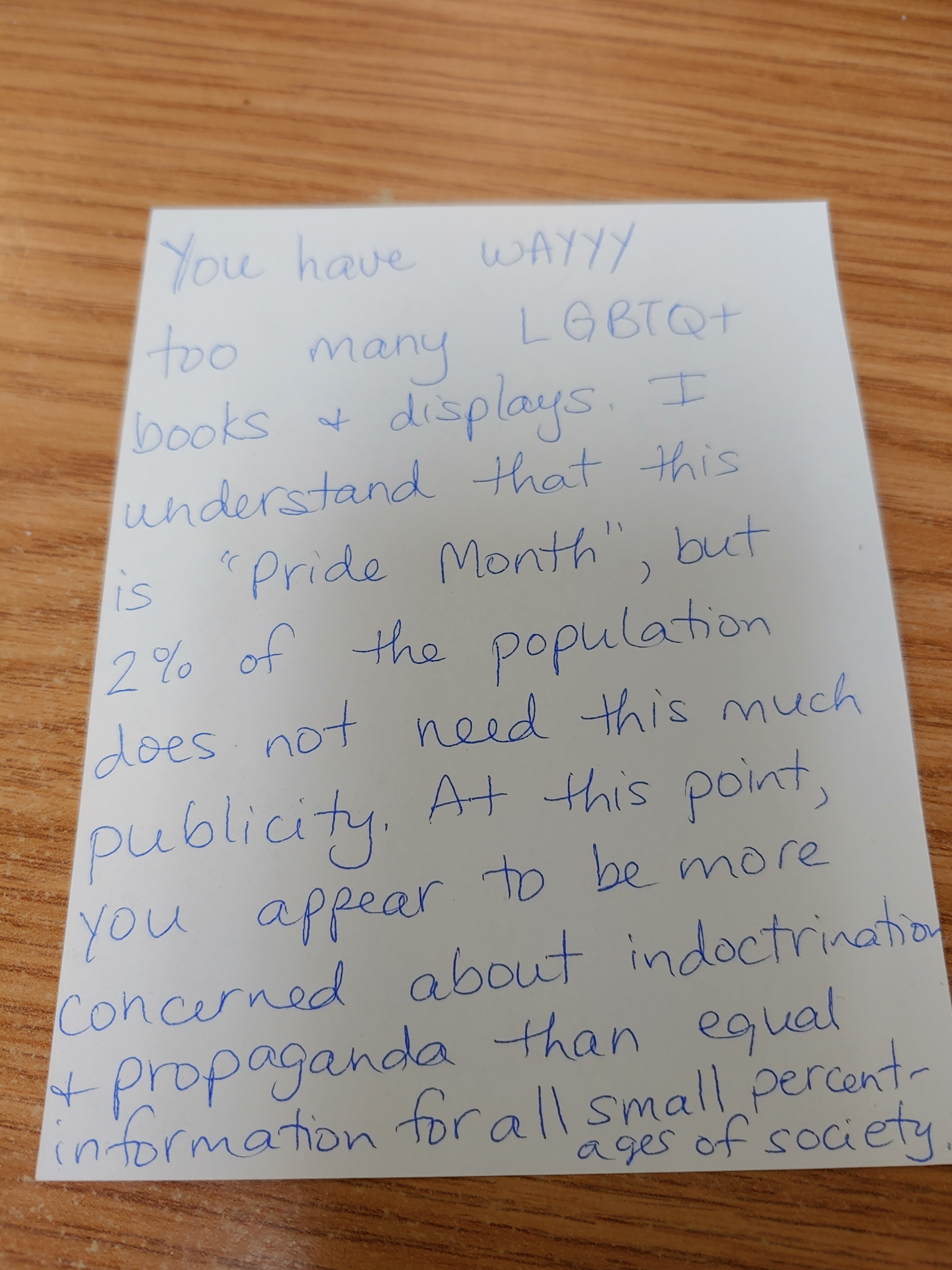
June is Pride month and it’s a month I love and dread in equal measure. June means I do Pride displays, colorful rainbow picture books and drag queen motivational books dot my shelves and my walls. I love seeing them but I dread listening to the vocal minority that begins to pop up.

Take those displays down.

Think of the children!

You’re too loud.

LGBTQ people don’t exist here.


It’s as though the displays remind people here that gay people live here. That they deserve representation. That the quiet unheard lives they lead should be enough right? Be invisible, be silent is the message I hear again and again.

The more vocal of them shout slurs at you if you walk through town wearing a rainbow sweater.

The less vocal get together on Facebook and sign petitions to remove books and displays because only straight white Christians should have a voice or be heard.

This year I took it, I took all of it and did something either brave or stupid. I kept the goddamn Pride flag up after June. I put it in the front window so that anyone who drives by sees it. Knows that in my library there is no “tolerating” of others. We accept everyone. We embrace everyone.

Libraries are not neutral, they are radical as fuck. MAGA books are shelved with All Boys Aren’t Blue. Mein Kampf is next to the Quran. No matter who you are, I guarantee your library represents you in some way.

One of the folks who works for our library board has made it their mission to get the flag down. Even threatened to take funding away from our library if we don’t take it down. She’s been recorded at meetings (yes this is a small town which are usually full of messy bitches who live for drama, who will record you saying stupid things) espousing this rhetoric.

Now I am conflict averse to a disturbing degree. I’m the kind of person who won’t send the wrong food back in a restaurant. But I can’t make myself cave on this. Our community is not all white Christian people who marry other white Christian people. Trans kids do exist. They commit suicide in towns like mine. Same goes for anyone on the LGBTQ spectrum. They deserve representation and respect.

Almost weekly someone comes in and asks me about it. Some are curious. Some are mad. Some write notes because they too are conflict averse but still need to get that point across.

It’s incredibly stressful for me. I think about taking that flag down many times. How much easier it would make my life. How I wouldn’t have to deal with angry white women or men who flap their hands to simulate limp wrists.

And I can’t do it.

I can’t take the flag down.

I can’t take that path.

My library has books for everyone. It has a rainbow flag. And you are welcome, no matter who you are or who you love.

Next Door

Jul. 29th, 2024 12:08 pm
yachiru: (Default)
Title: Next Door
Prompt: Uncanny Valley
TW: Death


Cindy discreetly moved her front curtain out of the way so she could spy on her new neighbor. He was in his twenties, she thought. At least fifty years younger than Siph.

He had spiked hair, blonde at the tips, and thick green glasses wider than his face. His pants were disturbingly tight. She wished she’d bought those opera glasses Louise had been trying to sell after Harold died.

His eyes widened as he noticed her small one bedroom cottage across the street. He smiled, revealing crooked white teeth, and waved at her.

She sniffed and retreated. It was only fun if they didn’t know she was watching.

Cindy had been through four neighbors in the ten years she’d lived in the neighborhood. The house across the street never seemed to keep people for long. It sort of repelled renters. The owner’s had tried to paint it a cheerful yellow two years before but it had faded to a sick looking puce that her great grandniece called pustule yellow.

She had almost fallen asleep on her ancient flower patterned couch while watching a Survivor marathon when she heard a knock at the door. She opened her blurry eyes to check the thick clock on top of her tube television.

Seven fifteen. Whoever heard of visiting at seven fifteen at night?

She grumbled, straightening to her full height in a series of painful maneuvers. Her fluffy slippers were right next to the couch so her feet didn’t get cold on the hardwood floor.

“Who is it?” she shouted at her closed door. You could never be too careful with thieves and murderers about.

“I’m Harley, your new neighbor. I brought you some cookies.”

She frowned but opened the door. The young man was there, wearing those tight pants.

“Your pants are too tight,” she said.

He laughed nervously and looked down. “I guess they are but they look nice.”

Cindy did not feel like laughing. “It’s late.”

He looked down at the container in his hands. “Sorry, I’ve been in loading mode all day. The time must have slipped my notice. I made you some oatmeal cranberry cookies. I thought you’d like them.”

He held out the cookies and she took them, not knowing what else to do.

“I’m Cindy Rockwell,” she said, unable to say much else. She wasn’t happy with any of this and felt sleepy. She wanted to go back to the couch and sleep curled up with her pillows.

“Harley Patterson,” he said. “Sorry for the disturbance.”

She sniffed and closed the door on him, waiting until she heard him walk away to open the container and tip the cookies into her garbage can.

Cindy woke with a mouth full of cotton. She stretched her jaw and made her morning tea, a bitter black leaf that reminded her of coffee. She watched the morning news. Apparently murders were on the rise in her town.

“It’s never good news,” she said, to hear herself speak.

Dorothy knocked at around eleven. Cindy was dressed in a new yellow pullover and green slacks. She wanted to look good for her Romance Book Club which met weekly at one of the member’s houses.

Dorothy might have been older than Cindy. Her face was more wrinkled, set in a permanent scowl not unlike a bulldog.

“We’re gonna be late,” Dorothy said.

Cindy sighed as she got in the passenger seat. “Those old women will wait for us.”

They were meeting at Nancy’s house that week so Cindy had brought some toast with avocado smeared on it. She knew Nancy would hate it.

Lucinda and Louise were already there, sitting at the dining room table, sipping tea. They were waiting for Susan, who was always the last to arrive.

Cindy sat down gingerly.

“Have you read the one about the door yet?” Louise asked Lucinda.

“Where she falls in love with a door?” Lucinda asked. “One of my grandchildren bought it for my Kindle. It was strange but good.”

Cindy sniffed. “In my day we just read books about dukes and duchesses. They were classy.”

“You mean rape-y,” Nancy cut in.

Cindy rolled her eyes. “They got married after.”

“Oh so that makes it legitimate,” Nancy said, hiding a smile behind her hand.

Cindy scowled. “Still a better plot than falling in lust with a door.”

Susan finally showed, sweating and carrying a tin full of muffins. The muffins were so good no one complained about the forty minute wait.

They discussed books for an hour or so, snacking and discovering the fine plot points of an arachnid erotica. Cindy couldn’t stop thinking about Harley though.

She interrupted towards the end of the meeting, asking the girls what they thought.

“Skinwalker,” Lucinda said.

“What the hell?” Dorothy asked.

“No, I read a romance once with a skinwalker, they come from Native American folklore, no?” Susan asked.

Lucinda nodded. “My grandfather was Cherokee, he told me about them. Strangers who approach and want your skin so they can shift into it. Animals too. You should watch for animals going missing in your neighborhood.”


Nancy laughed. “Ya’ll read too much weird romance. No such thing. He’s just a nice boy who gave you cookies. You always see the dark side of life, Cindy.”

Cindy thought there was precious little light left. She wondered how Nancy would feel with blurry vision and creaky knees. Some days Cindy couldn’t even get out of bed, she just stayed in, reading and knitting hole covered blankets.

She saw Harley outside, mowing his lawn on the drive back.

“He seems nice,” Dorothy said. “Don’t let the girls scare you. You could use a friend close by who could help you if you fell.”

Cindy sniffed. “As if I would ever.”

Dorothy shrugged and helped Cindy inside.

It was dark when Cindy heard a knock again. She didn’t want to answer it but felt compelled to.

Harley was at her front door again.

“Could I have my container back?” he asked.

She hadn’t bothered to look at the clock but she knew it was much later than when he’d come before. She opened her mouth to tell him to go but the words wouldn’t leave her. She turned around to get him the plastic container.

She felt a pulling sensation, it didn’t hurt or wrench. All she felt was pressure and then she was staring at her own face with Harley’s smile.

“What?” she asked dumbly.

“I’m a skinwalker, though you probably guessed that. I take faces. Or souls, to be particular.”

“Why would you want mine? I’m old,” she said. Her lips were numb. She felt her knees collapse as she sank onto the floor.

“Collectability,” he said, snapping the consonants at the end.

Her last thought was that she should have put on the red lipstick. Oliver had always liked her in it. Said she looked murderous.
yachiru: (Default)
Title: Recipes for Grief
Prompt: Without You
TW: Death


I don't want to write about grief anymore

I don't want to write about how it fits like an old jacket
that I keep having to patch the elbows on
how every year the shoulders tighten
buttons fall in the same patterns as falling leaves
from old bark trees
we used to make angels under

I don't want to write about all of the women dying in winter
my grandmother and mother gifting me Christmas ashes
how they sold her underwear in yellow plastic tubs
how her jewelry rubbed green
how she never got the funeral she wanted
gilded and grand

I don’t want to write about how I killed a mouse once
after its foot was caught in a snaptrap
how it woke me at three in the morning
frantic death squeaks all trapped creatures must make

I don't want to say that it made me remember my mother dying
on that dialysis machine
tubes pumping her veins clean
though never enough to counteract weeks of sin

There must be a recipe
for grief
something like tea using dust instead of leaf
filter through sleep
steep in water
let it wash me clean
yachiru: (Default)
Title: Baby Hatch
Prompt: Sankofa
TW: Little bloody

Petyr was elbow deep in a bag of Cheetos when his ancient brick of a Mac started to buzz. He frantically wiped his hands on his brown overalls, smearing orange dust on his crotch as he rushed to stand.

He walked briskly through the steel hallway, the pale yellow lights flashed sluggishly along the walls.

Pictures of babies were hung every few feet. Some had five or six eyes, some had tentacles for arms. All were swaddled in red clothing with the slogan “Yokai Hatch” repeated in big block letters.

Karen from Accounting opened the door of her office as he was breezing past.

She squinted at him from behind large gold round frames. She held a Big Gulp between her furry paws.

“You need help?”

Petyr shrugged. “As long as it is not oozing or has rows of serrated teeth I’ll be fine.”

She took a long sip, nodding. He knew she remembered Basil, who almost took Greg’s arm off last summer.

Greg worked in the basement now, reviewing camera feed behind a locked door.

Petyr loped off for the front of the building, where the hatch lived. He thought of how it looked from the outside, a drawer of metal carved into the outside wall. Messages about safety were taped on it, along with warnings not to leave pink cheeked babies who might get consumed. The drawing of a human baby with a large red NO overlaid on it was particularly inspiring to him.

When someone put a child in the hatch, it gently deposited them into a square plastic container, drilled with small holes. It was enough to contain most creatures though one or two had managed to escape.

One was a gelatinous ooze named Partridge who slithered out through a miniscule cap between the cover and the frame. The other was a fox demon who simply ate through her cage. She’d torn her way through most of the office before Helen from Dairy managed to subdue her. Helen had said it was easier than wrestling cows.

In the box was a small lump so black it absorbed the light. Petyr put on his gloves and started to hum a soothing song.

“Hello baby, hello,” he sang.
The lump moved sluggishly towards his voice. It seemed almost sad.

“It’s okay,” Petyr said, opening the lid. “You’re safe with us. We have lots of lovely people who will care for you.”

He gingerly opened the lid, wary of teeth or arms.

The baby rolled a little but stayed still. It was a little bigger than the palm of Petyr’s hand. He grabbed a swaddling cloth and wrapped it around the baby’s body, cradling it in his arms.

“You’re okay,” he said.

He couldn’t see any eyes or arms. Nothing escaped the blackness of the baby’s skin. He started towards the nursery when he felt the building shake.

“Oh shit,” he said. “Earthquake.”

Real earthquake, not a drill. Though he knew where to go next from the drills he’d been to a few months before. Terrible things, drills. All that standing around and doing nothing. He kind of regretted bitching so much about them now. He knew where to go.

Around him, doors opened as employees left their offices to join him in the gym which had been built to double as a shelter in cases like this.

The walls shook even harder, some ceiling tiles came down on them as they all ran for the gym. Petyr cradled the baby to shield it from any falling debris.

Everyone was holding their phones, frantically looking for news. There wasn’t any.

The building stopped shaking. Petyr huddled near a wall. This didn’t feel like an earthquake, was all he could think.

In his arms, the infant let out a piercing noise that sounded eerily like a siren.

He heard a loud crack. Parts of the ceiling broke off and rained down on everyone.

“Get back!” he heard someone yell.

They all shifted to the back of the gym as the ceiling split open.

A round eye looked down at him. The baby’s cries ratcheted up. A piece of stone fell and cut the skin above his right eyebrow. Karen rushed over, tearing off her scarf and applying pressure.

“Is it here for you?” Petyr whispered. It happened that the parent regretted leaving their child sometimes. Not often, but there were procedures that had to be followed.

“We can’t just give it back,” Karen said. “We have forms to fill out. In triplicate!”

“I don’t think it’s going to wait for paperwork,” Petyr said, wiping the blood from his eye. He could taste it on his lips now, hot and metal.

He took the wiggling baby, brushing its tentacles away as it swiped at his face.

“Come on now,” he said, crooning at where its face would be. “We’ll get you back to Mom and Dad.”

He wasn’t sure if either term applied. He thought the monsters produced asexually but he’d never bothered to research much about them before. He’d probably have to change that.

The baby made a gurgling noise and projectile spit a glob of green goo at him. Petyr gagged, coughed, and kept going.

He held the baby up to the giant eyeball. His knees shook. He locked them and firmed his chin.

“Look, he’s here. This tantrum needs to end. You know the policy of our institution. We are more than happy to return what was left. This is impolite and unacceptable behavior. You’ll need to leave your name and contact information so we can bill you for the damages to our building.”

He heard a wail from one of the workers still in the room.

“Probably for therapy bills too,” he added.

The eye went away, an ink-black tentacle replaced it. It was twice as tall as Petyr and so big around it had to knock more of the wall away to get through. It gently picked up the baby who stopped crying once it was held.

“Thank you for your patronage,” Petyr yelled after it.

He fell on his butt as the monster drifted away, his legs would no longer hold him.

The hole in the ceiling was open and he could see the stars through them.

He laid all the way down, looking up, almost wanting to smile.
yachiru: (Default)
Title:All is Well
Prompt:Someone who will love you in all your damaged glory
TW:A little gore
----------------------

Urie clicked the lights on and off three times. He did this twice more, running his hand over the wood veneer of the light switch.

9:15 and all was well. Or at least it would be once Urie checked on his chickens, his goats, and Clem, the cow.

He knew it was late and they’d all be asleep. Knew it wasn’t really normal to need to go out into the darkness.Every night he thought about it, staring at the rifle he kept behind his cabin door.

He thought about the night years ago when he’d woken at the same time. Something had told him to check the fence or the wire. But he hadn’t gone out and the next day he’d found all of them dead. Lumps of flesh torn in two, hardly recognizable as animals.

Urie still dreamed of those parts. Most hadn’t even been consumed as though the wolf killed them for fun.

The sky was dark, he imagined the stars gone as empty sockets where light bulbs should be.

Urie clicked the lights on and off three times.

He shrugged on his sheepskin coat and took the gun out from behind the door. He held it in his hand and thought about what would happen if he went out with it. If he found the wolf and shot it dead.

Would he stop dreaming about legs still twitching and body parts torn into twos and threes? Would he stop dreaming of grass so red?

Urie looked at his mantle.

There weren’t any pictures of him in his house. He’d often had the thought that a picture would make him a real person. Or that a part of his soul would be held there in the frame.

Urie clicked the lights on and off three times.

He thought maybe if he shot the thing he was afraid of he wouldn’t dream anymore. But he knew if he killed one another would hatch in the forest, slithering from its shell to Urie’s farm. It would not be deterred by the high fences or the sharp wire.

He left the gun at his door.

9:15 and all was well as he checked the fences that were too high and the sharp wire that wrapped around them. He listened to the chickens, wishing he could dream their chicken dreams. He watched the goats all curled up in a goat pile.

Clem leaned her head over the fence, gently nuzzling the red curls at the top of his head.

“You love me don’t you?” he asked her soft black nose.

He rubbed her ears for a second. Her eyes crossed.

She sneezed violently, blowing liquid onto his face and beard.

He laughed until one of the chickens came out to peck at his boots.
yachiru: (Default)
Maybe maybe maybe? Signing up for ljidol because I can though you're mostly getting horrible poetry.

Kummerspeck

Mar. 2nd, 2022 09:57 pm
yachiru: (Default)
Gelfred often watched his neighbor through the wide window in his own kitchen. The boy was called Alfie, a name that sounded cute and harmless.

But Gelfred knew the boy’s secret.

Each night, the boy sat at his desk and opened a small wooden box. Inside the box was a large round object that Alfie would cut into.

The next day a country would disappear. Gelfred would ask his neighbors if they remembered Poland or Pluto.

No such place, they’d say.

Which meant that the boy was eating the world. One bite at a time. Planets too. Oceans and land and all the people in between.

Well Alfie had to be stopped didn’t he? Gelfred planned to act before Denmark or Saturn went as well. He quite liked the rings around the latter.

In the morning he put on his tweed suit and clipped on the red bowtie Millicent always said made him look official.

He hadn’t been next door physically in years. Not since Alfie’s parents and grandparents all died on an ill-advised trip to Disney World Scotland when they ate haggis on a stick that had spoiled.

Alfie had come back hollow eyed, his ribs protruding in a disturbing manner. Most in town had avoided the boy after, for fear whatever was haunting the boy would manifest in them.

Gelfred had thought the boy was getting better. For sure Alfie had gained pounds and pounds, filling out until he resembled a cooked dumpling.

Gelfred could still see the boy’s ribs, above the potbelly and waddling knees.

Alfie’s door looked different. Gelfred remembered a cheerful lion door knocker with a ring through its mouth. The lion now had the patina of old metal and snarled, making him hesitate to use it.

“You won’t give me a disease?” he asked the metal lion anxiously, wringing his hands.

He knocked once and waited. If no one came to answer he could at least say he tried saving the world.

Five minutes later the door opened a crack.

“No solicitors,” the voice croaked.

“Is that you Alfie?” Gelfred asked. “I came to speak with you but I’m not selling anything. Unless you’re interested in some very fine china I found at a yard sale last week. It’s got little blue octopuses painted on it. Quality work.”

The door opened and there Alfie stood. His shirt was stained in bruised purple and green stains that matched the patches of food on his chin.

Gelfred squinted. “You’ve been eating Finland haven’t you? I can see fjord drippings on your neck.”

Alfie shrugged and turned around, leaving Gelfred to pick his way through newspapers and empty cans on the floor.

Tetanus shot tomorrow, Gelfred vowed.

Alfie had carved himself a single spot on the couch in the living room that was free of trash. He curled up on his spot, eyeing Gelfred suspiciously.

“Tired of spying on me?” Alfie asked.

Gelfred sniffed. “I know what you’re doing. My Milly has been gone over a decade and I still have urges to swallow large parts of Canada but I resist because Milly always liked those Mounties. Also eating large parts of anything is wrong. Gives you indigestion.”

Alfie stared at his hands. “What am I gonna do then? When sadness empties my belly so that I hunger and hunger with an appetite so big I might as well be inside out?”

Gelfred peered down at his feet. “Well first we clean up your space a bit. Give you some walking around room.”

“And then?” Alfie asked.

“Then,” Gelfred said, “I suppose we can decide from there.”

Just to be safe, Gelfred took the wooden box with him when he left. He liked to take it out sometimes, wondering what Mozambique tasted like.
yachiru: (Default)
Prompt: What Really Matters


When Gumshoe the Gnome went missing Madge walked the halls, looking in each cubicle for the culprit.

Eric from Accounting had a gnome but it wasn’t four foot tall and had no red bowtie. She smashed his secretary lamp and tipped the gnome over.

Tiffany from Sub-Basement B had a lovely unicorn on her desk but someone had set it aflame and Madge didn’t care for the smell of scorched majesty.

She’d searched almost everywhere but had found no sign of Gumshoe.

It had to be one of the wicked spirits, perhaps the twins or Karen from Finance, she thought.

Madge decided to ask the Rooster, he worked on the highest floor and knew everything there was to know.

Elevator. The halls twisted around her, forming patterns from alternating checkerboard patterns. An ancient elevator appeared, the iron doors opened.

She whispered the secret phrase.

Lambshanks.

Inside, the round floor lights lit up on the panel. The elevator began to move.

At floor one-hundred, the doors opened and Madge peeked her head out. The walls on this floor were bruised shades of pink and blue. The ground was made of soft grass. She kicked off her shoes, enjoying the cool wet strands.

She’d missed this floor, she thought, as she walked towards the giant tree in the center of it all.

The Rooster met her there. He resembled an owl rather than his namesake. White and tan feathers formed a halo around his sharp smile. At his feet stood Gumshoe the Gnome.

Madge gnashed her teeth, stomping until the young grass under her feet wilted and browned.

“You moth-riddled arse! How dare you steal what is mine?!”

The Rooster laughed, the sound shook the tree branches above him, shaking fuschia leaves onto his shoulders.

“Was it yours? I found him while weeding some crabgrass. Let us negotiate.”

The sound of bells filled Madge’s head. Dust stung her eyes. She closed them, rubbing the back of her eyelids with her closed fist. When she opened them she saw no trees or grass.

They sat in an office across a table. Gumshoe stood on top, wearing what Madge considered his most judgmental hat.

“Give me the gnome and I will only smash half of your things,” Madge said.

“Never!” The Rooster said, chuckling into his chest.

“You are too cheerful for this negotiation!” Madge shouted.

The Rooster shrugged. “You do not call or visit with me anymore. What else was I to do? It’s lonely here with only the wind and mounds of paperwork yet to be done.”

Madge narrowed her eyes. “I will visit with you but I must have Gumshoe back. You will serve tea with real cream. I may or may not smash some of your things.”

The Rooster nodded and slowly edged Gumshoe the Gnome over to Madge’s side of the table. She admired his bright blue eyes and jaunty chin, clutching him to her chest.

“Karen from Finance did not appreciate you, but I do,” she whispered.

Le Idol

Jan. 3rd, 2022 01:45 pm
yachiru: (Default)
I could probably do this again. Trying to write more this year.
yachiru: (Default)
In winter we hunt mermaids. As our fathers and our father's fathers have done, passing along their secret hunting grounds like an echo of genetic memory.

I wonder that the same isn't so for the creatures we hunt. Instinct alone should have guided them to better hibernating locations yet daughter after daughter is born, only to die inside their winter homes.

Perhaps something inside each is a cruel spirit, each whispers to each; safe here, safe here.

I know their hearts are tough. Usually the dogs won't even eat them. I know which parts are tender and which are bitter. I know how to crack bones for soup and how delicately sharp the knife must be to remove the scales without damaging them.

My daughter makes necklaces, sells them to tourists.

Look at how beautiful, my daughter tells them. Don't you want to be beautiful too?
yachiru: (Default)
So I went a little insane and wrote a children's book. >_>


Princess Amelia was tired of the tower. There were all those stairs. She spent more time climbing up and down than anything else. And by the time she was on either side, she was too tired to do anything. So she stayed at the top, waiting.


Her Prince was coming. He would save her from this tower and marry her and they'd ride away on two white horses. She wasn't sure about the married part but she quite liked the idea of horses.


She'd started talking to the castle mice long before her first suitor showed. Phillip was her favorite because he was a terrible gossip and she loved learning about what those evil birds were up to.

She couldn't see much of the first prince. He was covered head to toe in armor and when the sun hit him, he resembled a rather large sparkle.

"Hello, fair maiden," he shouted. "I have come to save you."

"Save me," she said to herself. "It's not so bad here. Food magically appears and I have a nice view of those pretty mountains."

Princess Amelia told the prince to win her he'd have to climb the great staircase in his armor.

She spent the rest of the day gossiping with Phillip, to the sound of a steady staccato clang clang clang as the prince fell again and again.

He left the next day, limping into the forest.

The second prince wore a bright red feather on his cap. Phillip was immediately suspicious and told Amelia he was sure the prince was with those awful birds.

He and his brethren invaded the prince's camp and stole everything. Phillip stole the prince's hat and fashioned one for his very own.

Princess Amelia was very disappointed. None of these princes were real princes. Not one white horse. Not one lovely sonnet.

The next to approach the tower were all too something. One was too fat. He couldn't even make it up the very first flight of stairs. Two were too dirty. Dustclouds surrounded their (not white) horses. And the last.


The last, he was the worst of all. His name was Prince Corncake and he only had the one white horse to his name. Still, it was a very pretty horse.

"Take the tower," she said. "I shall take your horse and you will stay here. Pretend to be me."

She cut off her hair and fashioned a wig from it.

"There," she said. "Now just send those princes away when they come courting. Tell them you've developed boilitious. I have no idea what that is but it sounds dreadful."

She paused. "Also once a month wild hogs come and celebrate. They bring their own wine but the noise can be distracting."

She patted Prince Corncake on his newly coifed head and rode away on her very own white horse. She named her Isla, after the mountains that Amelia could see from her tower.


"Shall we go and see what's on those great mountain tops?" Amelia asked.

yachiru: (Default)
rosa, the robot

she has seen machines
churning waves of metal
burning skies until skies were black

she fixes
cars-she unmuffles mufflers
attaches
shiny
wheels
over real wheels
make it louder-replace
ears-add muffler

factories thicken
urban gravy-rosa
applies spikes
bare knuckle tires
unmuffles mufflers
applies garbage bag
to headlight

the future is bright
chime in her ear-she
can't hear never fixed
that part

she watches cars become men
humping each other for oil slick
nothing sick-these are all american
manufactured biomechanical reality


yachiru: (Default)
The soft thump wakes her. Meryl groans and rolls over, staring at the white popcorn ceiling above her bed.

She thinks about going back to sleep. Pretending she hasn't heard a sound.

"Fuck," she mutters under her breath.

She sits up, legs dangling over the side of the bed as she bends over and reaches under for the wooden baseball bat. Her grandfather's, solid and heavy in her hands. He'd carved strange symbols over it, said they were Viking runes of protection.

The old man had been full of shit but she likes the look of them. The curving hooking lines that circled around the base were stained a dark red.

He'd always fancied himself a berserker. Meryl snorts at the thought.

She wiggles into a pair of ancient flip-flops near the foot of her bed, not bothering to change out of her gray tank and shorts.

The bat drags behind her as she turns on the porchlight.

The body isn't too far away. A man shape slumped against her old apple tree.

Blood tree now.

She lights her cigarette, inhales fire. Must be like the flytraps. Damn things just singed themselves until there was no help for them.

She smokes until her lungs burn. Smokes until nausea crawls up her throat.

The body isn't going anywhere but she can hear the soft pained wheezing of the creature.

She curses, stomps out her cigarette, and takes up the bat again.

She sees the wings first, as wide as her body was tall. Soft downy feathers surround him on the ground.

He speaks in a thousand voices. "Help me. Help me."

"Yeah," she says.

He makes no sound when the bat hits him. She hears only the thwack of the wood hitting bone. She has to swing hard. Her arms are tired by the time he dies. Blood covers her face. It tastes of flowers and spoiled fruit.

The earth beneath the tree will swallow the body come morning.

She should leave them to die. Let the damp or the cold do their job.

But she never could abide suffering. Even if angels were dumb as rocks.

Profile

yachiru

Style Credit

Expand Cut Tags

No cut tags